
Getting Your Buffalo Trees Ready for Lake-Effect Season: What the October Surprise Still Teaches Us
 kdassociatebfinc@gmail.com
October 20, 2026
15 min read
If you lived in Buffalo in October 2006, you probably remember the sound before you remember the snow. Branches cracking like gunshots in the dark, one after another, all over the neighborhood. This week marks twenty years since that storm, and for those of us who work in trees for a living, it is still the clearest lesson we have about what our local weather can do to the trees around our homes.
At Urban Oak Tree Service, we’re a small, ISA-certified crew working out of Niagara Street, and we spend our days in the backyards, side lots and tight city driveways of Buffalo and the surrounding towns. This guide is what we’d tell you if we were standing in your yard with a cup of coffee: what to look for, what you can safely handle yourself, what you really shouldn’t, and when it’s time to call a professional before the first heavy lake-effect band rolls in.
What the October Surprise Taught Buffalo About Trees
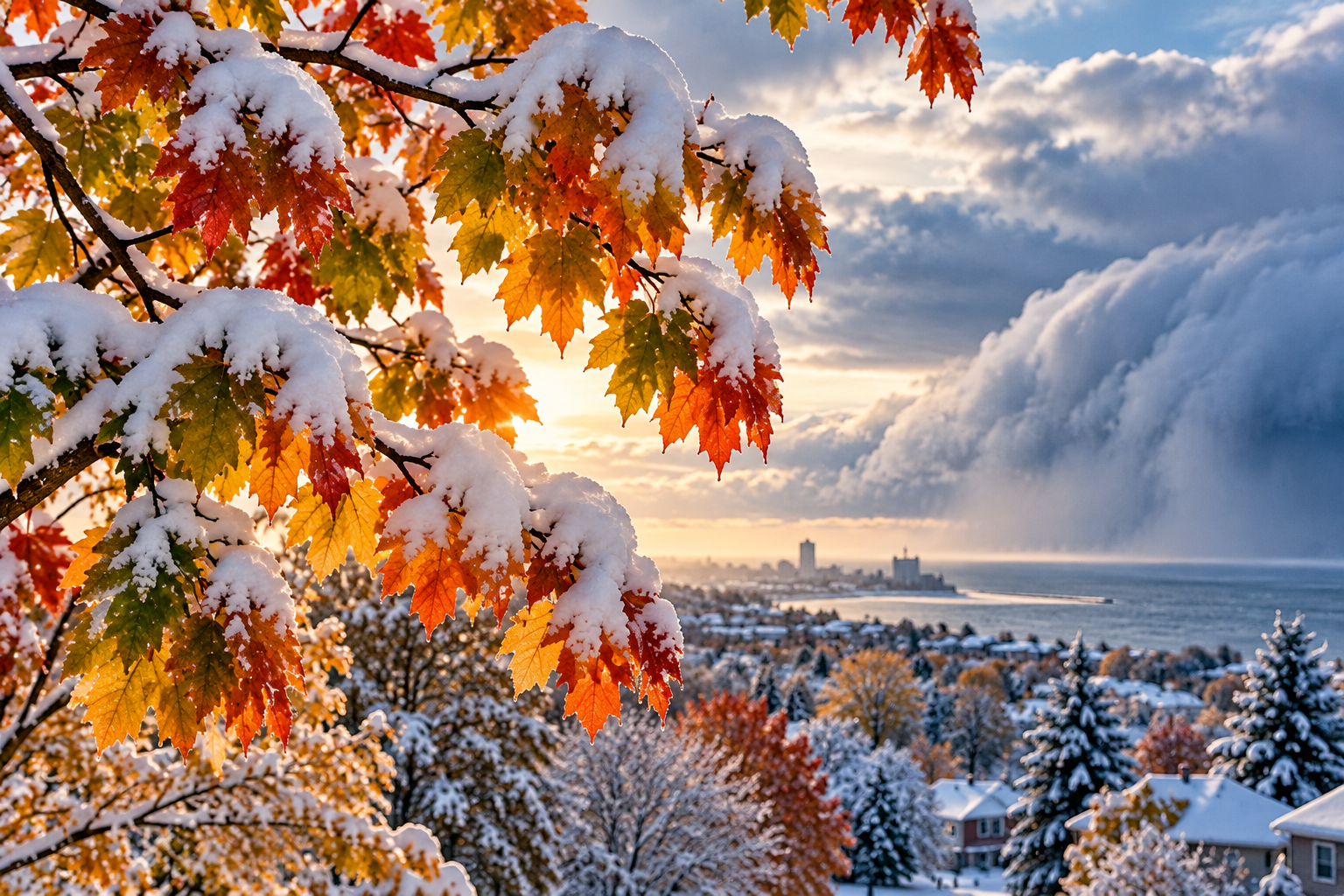
Here is the short version of what happened. On October 12 and 13, 2006, an early lake-effect storm dropped heavy, wet snow on Western New York while the trees were still holding their leaves. According to the National Weather Service in Buffalo, the airport recorded 22.6 inches, far beyond any previous October snowfall, and almost a million residents lost power, some for as long as a week. The NWS summary calls the tree damage the worst in memory, especially in the city’s historic parks and parkways.
Two details from that report matter to every homeowner reading this today.
First, the snow was wet and dense. The NWS notes a snow-to-water ratio of roughly 6:1, which is why it was so destructive to trees and power lines. Light, fluffy snow slides off a branch. Heavy, wet snow clings to it, and a mature tree with a full canopy can hold an enormous amount of weight.
Second, the ground was saturated. The NWS also pointed out that the wet soil made it easier for root systems to fail. Trees don’t only lose limbs in storms like that. Sometimes the whole tree tips over, root plate and all.
Local news coverage this month, including Spectrum News’ 20-year look back, notes that the replanting effort began in 2007 and that questions remain about how fully Buffalo’s canopy has come back. That’s the part we find most useful. Two decades on, many of the trees we’re asked to look at are survivors or replacements from that era, and they carry the scars: old wounds, poorly healed tears, and weak branch unions that were never corrected.
We aren’t telling you this to scare you. Buffalo’s trees are one of the best things about our neighborhoods, and the vast majority of them will get through this winter fine. But a bit of attention in the fall is the cheapest storm insurance there is.
Why Lake-Effect Season Is Hard on Local Trees
Anyone who has lived here for a winter knows that our weather doesn’t behave like it does in other parts of the country. A few things make life tough for a tree in Erie County.
- Early and late snow. Storms that hit before the leaves drop (or after buds swell in spring) put far more load on branches than a midwinter snowfall on bare wood.
- Freeze-and-thaw cycles. Water gets into cracks and wounds, freezes, and widens them. A small split in October can be a failed limb by February.
- Wind coming off the lake. Trees on open lots, along Niagara Street, and near the waterfront take a different beating than trees sheltered between houses in a dense neighborhood.
- Tight, built-up lots. In older Buffalo neighborhoods, a tree’s roots are often squeezed between a foundation, a sidewalk and a driveway, and its canopy hangs over a roof or a neighbor’s fence. That means a failed limb isn’t just a mess. It’s a claim.
That last point is the reason we describe a lot of our work as careful rather than dramatic. Plenty of the jobs we take on are the awkward, hemmed-in ones, where the answer is rigging a limb down in sections rather than letting it drop, so your roof, garden beds and fence stay intact.
Your Fall Walk-Around: What to Look For
You don’t need to be an arborist to do a useful first check. Pick a dry afternoon, grab a pair of binoculars if you have them, and walk slowly around every large tree on your property. Look at three zones: the crown (top), the trunk, and the base.
In the crown
- Dead or hanging branches. Dead wood is brittle and breaks without warning. If you see branches with no buds or leaves when the rest of the tree has them, or limbs that are broken and lodged in the canopy (we call these “widowmakers” for a reason), mark them.
- Branches over the roof, driveway or service line. These are the ones that cause the most expensive damage when they fail.
- Crossing or rubbing limbs. The rubbing creates wounds that invite decay.
- Co-dominant stems with tight “V” shaped joins. When two main stems grow up from the same point with bark squeezed between them, the union is weak and can split under load. This is a classic cause of trees splitting down the middle in heavy snow.
On the trunk
- Vertical cracks or splits, especially if they’ve opened up since last year.
- Cavities, peeling bark, or oozing sap that doesn’t look like normal wound closure.
- Mushrooms or conks growing on the trunk or roots. These can be a sign of internal decay that you can’t see from the outside.
At the base
- Soil heaving or cracking on one side. If the ground near the trunk is lifting, the tree may be starting to shift.
- A new or worsening lean. Many trees lean their whole lives and are perfectly stable. A tree that changed its lean recently is a different story.
- Mulch piled up the trunk like a volcano. It’s common in this area, and it holds moisture against the bark and encourages rot. Pull it back so you can see the root flare.
If you find one or two minor issues, take photos and make a note. If you find several, or anything that makes you uneasy, that’s the point to have someone look at it in person. Photos help, but a tree’s real condition is almost always clearer standing underneath it.
Trimming vs. Removal: How We Actually Decide
The honest answer most homeowners want to hear first is: “Does my tree have to come down?” And often the honest answer is no.
Our rule of thumb is simple. If a tree is structurally sound and its problems are limited to a few branches, we recommend tree trimming and pruning. Done well, pruning removes the dead wood, reduces the weight on weak unions, lifts branches clear of roofs, and improves the shape of the crown, all without hurting the tree. A few principles guide how we do it:
- We don’t top trees. Topping, which means chopping the top of a tree back to stubs, creates weak regrowth and open wounds. Professional arborists discourage it for exactly that reason. Proper pruning means cutting at the branch junction so the tree can seal the wound.
- We take only what the tree can spare. A widely used guideline is to avoid removing more than about a quarter of a tree’s live crown in a single season.
- We prune for a purpose. Every cut should have a reason: safety, health, clearance or structure. If someone proposes “thinning it out” with no explanation, ask why.
Sometimes, though, tree removal really is the right call. We’ll tell you plainly when we think so, and these are the situations where we usually do:
- The tree is dead or dying and sits near a structure, a driveway, or a lot line.
- The trunk or root system is structurally compromised, such as a large cavity, major root damage, or a significant lean that is getting worse.
- The tree has a serious disease or pest problem that can’t be reversed, as we’ll cover with ash trees below.
- The tree is the wrong tree in the wrong place, for example a fast-growing species too close to a foundation or sewer line.
When removal is needed, the way it’s done matters as much as the decision. In a tight Buffalo lot, we lean on rigging and sectional felling rather than dropping a big tree in one piece and hoping for the best. It’s slower and more deliberate, and it’s the reason lawns, fences and rooflines survive the job.
A Local Problem: Ash Trees and the Emerald Ash Borer
If you have an ash tree on your property, it deserves its own look this fall.
The emerald ash borer is a small metallic-green beetle from Asia whose larvae tunnel under the bark of ash trees and cut off the flow of nutrients. It was first detected in New York in 2009, and Cornell researchers confirmed it in South Buffalo in 2011. Ash makes up a notable share of the tree population here. Regional sources have estimated it at roughly one in seven to one in five trees in Erie County. According to Cornell, infested trees can die within two to three years.
Why does that matter for your yard? Because a dead ash becomes brittle very quickly, and it’s one of the more dangerous trees to take down. The wood can fail without warning, which is a significant safety concern for anyone climbing it. If you have an ash that’s thinning out at the top, dropping bark in patches, showing woodpecker damage, or covered in small D-shaped exit holes, don’t wait for it to fail in a storm. Have it assessed while it’s still safe to work on.
Street Trees vs. Yard Trees: Know Whose Tree It Is
This one catches homeowners all the time, so it’s worth a clear explanation.
The strip of grass between your sidewalk and the curb usually belongs to the city, and the tree growing in it is a city street tree. In Buffalo, the Bureau of Forestry manages those trees, and you generally need a Tree Work Permit to plant, prune or remove a tree in the public right-of-way. The city’s own permit information notes there is no fee for the permit, and the usual first step is calling 311 to request an inspection.
A few practical points:
- Don’t assume a street tree is yours to cut. Unpermitted work on a city tree can bring fines and replacement costs.
- Trees entirely on your private lot are generally yours to manage, though historic districts and some neighborhoods may have additional rules. If you’re not sure, ask before you cut.
- A reputable tree company will ask about this up front. If a crew shows up and starts cutting a tree in the tree lawn without any mention of a permit, that’s a red flag.
If you aren’t sure which category your tree falls into, we’re happy to help you figure that out during a free assessment.
When a Tree Comes Down: What to Do in the First Hour
Even with good prep, storms happen. If a tree or big limb comes down on your property, here’s what we’d suggest:
- Stay away from it and from anything it’s touching. A fallen tree may be resting on a live line, and it can be under tension that releases suddenly when cut.
- Keep people and pets back, and look up for hanging limbs before you walk near the area.
- Call the utility if there are wires involved (and never climb or cut near a line yourself), and 911 if there’s an immediate danger to life.
- Take photos from a safe distance for your insurance claim.
- Call a certified, insured crew. Cutting a tree that’s been loaded with snow or twisted by wind is a very different job from cutting a standing one. Storm-damaged wood can spring, split or roll in ways that catch inexperienced people off guard.
We run a 24/7 emergency tree service for exactly these situations, and a real person answers the phone day or night. Keep the number somewhere you can find it, ideally in your phone right now: (716) 321-5554.
Don’t Forget the Stump
After a removal, there’s usually a stump left behind, and it’s easy to push that problem down the road. A stump can sprout, harbor pests, trip someone, or sit in the middle of your yard looking unfinished.
There are two ways to deal with it, and they overlap a little, so here’s the plain-English version:
- Stump grinding uses a machine to grind the stump and major roots below grade, which leaves you with ground that’s ready to be filled, seeded or replanted.
- Stump removal is the broader service of clearing the stump from your landscape so you can reclaim the space.
Before any digging or grinding, utilities should be marked. In New York, you can request that for free by contacting 811 a few days ahead. Please don’t skip this step. A grinder doesn’t care what’s buried underneath.
How to Choose a Tree Company in Buffalo
Anyone with a chainsaw and a truck can advertise tree service, so it pays to ask a few questions before you hire. This is what we’d look for if we were hiring someone for our own home.
- ISA certification. The International Society of Arboriculture offers a voluntary credential, and holders must follow a code of ethics. You can verify an arborist through the ISA’s Trees Are Good “Find an Arborist” tool.
- Proof of insurance. Ask for both liability and workers’ compensation coverage, and ask to see it. A reputable company will happily provide proof.
- A written, itemized estimate. It should say what’s being done, what’s included (cleanup, wood haul-away, stump), and how long the quote is good for.
- No topping, no spikes on trees that are staying. Climbing spikes wound living trees, and topping damages them. If a company suggests either, keep looking.
- A plan for protecting your property. Ask how they’ll get the debris out, how they’ll protect your lawn, and what they do about tight access.
- Honest advice. The best sign is a crew that tells you when you don’t need the work.
That last one is baked into how we run things. We’d rather tell you a tree can be saved with pruning than sell you a removal you don’t need.
What a Visit With Us Looks Like
Since we’ve talked a lot about what to expect, here’s how we run a typical job so there are no surprises:
- Free assessment. We visit, look at the tree and the access, and talk through what you’d like done.
- Written estimate. A clear, itemized quote with no pressure, valid for 30 days.
- The work. A certified crew arrives on schedule and works carefully around your property.
- Clean finish. We clear the debris, rake the site, and aim to leave it tidier than we found it.
We serve Buffalo and nearby communities including Amherst, Williamsville, Cheektowaga, West Seneca, Orchard Park, Tonawanda, Kenmore, Lancaster, Depew, Hamburg and East Aurora. If you’re not sure we cover your street, give us a call anyway; there’s a good chance we’re already working nearby.
Frequently Asked Questions
How much does tree trimming or removal cost in Buffalo?
It depends on the size of the tree, how easy it is to reach, what’s around it, and how much cleanup is involved. Because every property is different, we price each job after seeing it in person rather than quoting a generic number over the phone. Our estimates are free and in writing.
Do I need a permit to remove a tree in Buffalo?
If the tree is a city street tree in the public right-of-way, yes. A Tree Work Permit through the Bureau of Forestry is required, and you can start by calling 311. Trees on private property generally don’t need a city permit, but historic districts and other local rules may apply, so it’s worth checking first.
Can a damaged tree be saved?
Often, yes. Many storm-damaged or structurally weak trees can be stabilized with corrective pruning, and a good arborist will tell you honestly when that’s an option and when removal is safer.
Talk to a Local Arborist Before the Snow Flies
Twenty years after the October Surprise, Buffalo still has a long memory about what a heavy, wet snow can do to our trees. A little attention this fall, a careful look, the right pruning, and an honest plan for any tree that really can’t stay, can make the difference between a quiet winter and a very long night.
If you’d like a second set of eyes on your trees, we’re glad to help. Browse our full list of tree care services, learn more about our crew, or request a free quote. You can also call us directly any time.
Urban Oak Tree Service
295 Niagara St, Buffalo, NY 14201
Phone: (716) 321-5554
Website: urbanoaktreebuffalo.com
Urban Oak Tree Service is an ISA-certified, fully insured tree care company serving Buffalo and Western New York. Information in this article is general guidance and isn’t a substitute for an on-site assessment of your specific trees.
Sources and further reading
– National Weather Service Buffalo: Lake Effect Summary, October 12-13, 2006
– Spectrum News: Buffalo snowstorm anniversary and tree recovery
– City of Buffalo Bureau of Forestry
– City of Buffalo Tree Work Permit Information
– Cornell: Emerald ash borer confirmed in Buffalo
– ISA Trees Are Good: Find an Arborist